How to Tell If a Website Is Fake: The Red Flags Scammers Hope You Miss


Key Takeaways
A fake website doesn't announce itself. That's the whole point.
Scammers don't build sloppy, obviously suspicious pages anymore. They copy logos, steal product photos, paste in customer reviews, and register domain names that look almost right. They mirror the layout of well-known retailers down to the font choices and footer links. The result is a site that looks trustworthy enough to fool a careful person, and that's exactly what it's built to do.
In 2024, Americans reported a record $16.6 billion in losses to internet crime, according to the FBI's Internet Crime Complaint Center (IC3). Phishing and spoofing, which fake websites power, were the top reported crime category. A Pew Research Center survey from 2025 found that 73% of U.S. adults have experienced some form of online scam or attack, with 36% saying they paid for something online that never arrived or turned out to be counterfeit.
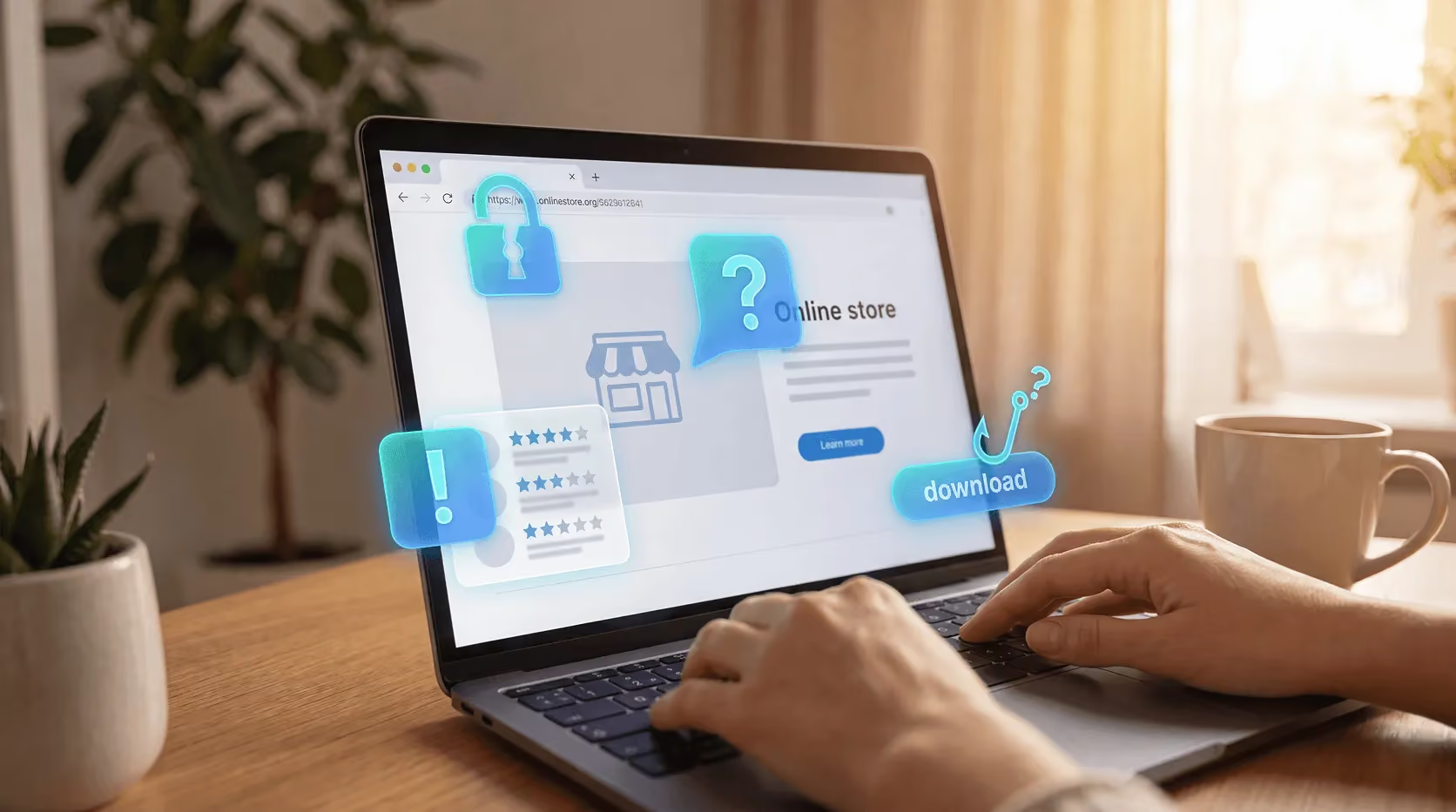
The problem isn't that people are careless. It's that scammers design these sites specifically to bypass the checks most people know about, the padlock icon, the professional layout, the customer testimonials. Each of those signals has been weaponized. Here's what those standard checks miss, and what to look for instead.
The padlock icon doesn't mean what you think it means
This is probably the most dangerous myth in online safety. People have been told for years: look for the padlock, look for HTTPS. If it's there, the site is safe.
It isn't that simple. HTTPS only means the connection between your browser and the site is encrypted, in other words, that data traveling between you and the server can't easily be intercepted by a third party on the same network. It says nothing about whether the site itself is legitimate or who is actually running it. Scammers figured this out quickly, and now they use SSL certificates too.
The FBI has explicitly warned that criminals routinely set up phishing sites with the padlock icon. According to reporting from Krebs on Security, roughly half of all phishing sites now display both the padlock and the HTTPS designation. Getting an SSL certificate is free and takes minutes through services like Let's Encrypt, so a professional-looking padlock costs a scammer almost nothing and can be obtained in the same afternoon they register a new fraudulent domain.
The padlock, in other words, tells you the channel is encrypted. It does not tell you the destination is honest.
What to do instead: check the actual domain name in the address bar, not just the lock icon. A site can have HTTPS and still be "amaz0n-secure-checkout.com." The encryption is real; the store is not.
The URL looks right, until you read it carefully
Scammers are patient. They register domain names that are built to pass a quick glance, the kind of glance most people give a URL before clicking through.
Common tricks include:
- Typosquatting: One letter off, "paypa1.com" instead of "paypal.com," "roblox.com.gifts" instead of "roblox.com." The substitution is easy to miss when you're reading quickly or on a small phone screen.
- Homograph attacks: Replacing standard letters with lookalike characters from other alphabets. The Cyrillic "а" and the Latin "a" are visually identical in most fonts, meaning a URL can look perfectly correct while pointing to an entirely different domain.
- Subdomain tricks: "paypal.com.verify-account.net", the real brand name appears early in the address, but the actual domain is "verify-account.net." Scammers rely on readers stopping at the familiar name and not reading further.
- Extra words: "official-apple-support.com" or "amazon-customer-help.com", these sound authoritative but are not affiliated with the brands they invoke.
The fastest check: click the address bar and read the domain name from right to left, stopping at the first slash. That's the actual domain. Everything before it is a subdomain, which anyone can control. So in "paypal.com.verify-account.net/login," the domain is "verify-account.net," full stop.
On mobile, this check is harder because browsers often truncate the URL. Make a habit of tapping the address bar to expand the full address before entering any personal or payment information.
The site is 'too good to be true', and so is the pressure
A 70% discount on limited stock, a countdown timer, a banner that says "Only 2 left!" These design choices aren't accidental. They're engineered to stop you from pausing to think, and they work, because urgency is one of the most reliable ways to short-circuit careful decision-making.
Fake shopping sites rely on this urgency. If you feel pressure to buy right now before the deal expires, that sensation is the point. Legitimate retailers want you to come back next week, next month, next season. Scammers need you to act before you look them up, before you check reviews, before you notice that the domain was registered three weeks ago.
Watch for prices that are dramatically below what you'd find on Google Shopping or at other major retailers. If a site is selling AirPods for $49 and has no reviews anywhere online, that gap has an explanation, and it isn't that you've stumbled onto a secret deal. Scam shopping sites frequently target popular, high-demand products precisely because the desire to find them at a discount is strong enough to override skepticism.
A useful rule of thumb: if the price would make you tell a friend about it in disbelief, treat that disbelief as a warning.
The contact information is vague or missing
Real businesses want to be reached. They list a phone number, a physical address, and a support email, and if you call or email, someone responds within a reasonable timeframe.
Fake sites often skip this entirely, or they offer a generic contact form with no other details. Sometimes there's an address that turns out to be a UPS Store mailbox, a co-working space with no connection to the brand, or a vacant lot. A customer service email that ends in gmail.com or yahoo.com instead of the brand's own domain is a significant red flag, legitimate companies invest in branded email addresses because it builds trust and is straightforward to set up.
Quick checks:
- Copy the physical address and paste it into Google Maps. Does it show a real business at that location, or a residential address, a parking lot, or nothing at all?
- Search the phone number separately. Does it come up anywhere credible, or does it appear on scam-reporting forums?
- Look for an "About Us" page. A thin or missing one, or one written in vague corporate language that could apply to any company in any industry, often signals a disposable site built quickly and intended to be abandoned after a short run.
If a site has no verifiable way to contact a real human being before you hand over payment information, that absence is itself the answer.
The payment options are unusual
Scam sites often push payment methods that can't be reversed. Cryptocurrency, wire transfers, gift cards, and peer-to-peer apps like Zelle or Venmo have one thing in common: once the money is gone, it's gone. There is no dispute process, no chargeback, no recourse.
Legitimate e-commerce sites accept major credit cards or PayPal, payment methods that carry consumer protections and dispute resolution built in. Credit card chargebacks exist specifically for situations where goods aren't delivered or a merchant turns out to be fraudulent. If a site asks you to pay via crypto or insists on gift cards for any reason, stop. No legitimate retailer requires gift card payment for a physical product purchase.
On top of that, look at the checkout page itself. Is the URL still the same domain you started on? Does the payment form look like it fits visually and functionally with the rest of the site? Scammers sometimes inject fake payment pages into otherwise-normal-looking sites, a technique that's hard to spot without looking closely at the address bar at the exact moment you're asked to enter card details.
If the checkout experience feels disjointed, or if you're redirected to a domain you don't recognize at the payment step, close the tab.
Reviews and trust signals are copy-pasted
A site with five-star reviews is not automatically trustworthy. Fake review generation is cheap and widely available, and many scam sites either fabricate reviews wholesale or copy them directly from legitimate retailers, sometimes lifting entire review sections from Amazon or Trustpilot and republishing them verbatim.
Trust badges present a similar problem. Logos for "Verified Secure" or "SSL Protected" or "Norton Secured" can be copied and pasted as images by anyone. They carry no actual verification unless you can click them and confirm they link to a live, valid certificate from the issuing organization.
A few ways to test the reviews:
- Copy a glowing review and paste it into a Google search with quotation marks around it. If the exact text appears on multiple unrelated sites, it's been duplicated and is not genuine.
- Look up the site on Trustpilot, the Better Business Bureau, or Reddit. Absence of any independent reviews on a site that claims to have been operating for years is suspicious on its own, real businesses accumulate a trail.
- Check when the domain was registered using a free WHOIS lookup tool. A site claiming to be an established brand with years of happy customers, but with a domain registered two or three months ago, is a clear warning sign that the backstory is fabricated.
What to do when something feels off
Trust that instinct. If a site makes you hesitate, even if you can't immediately identify why, don't push through it. Scam sites are built to create just enough legitimacy to overcome doubt, but that doubt exists for a reason.
A few practical steps that take under two minutes:
- Search the business name + "scam" or "reviews" before buying anything. Real complaints surface fast, often on Reddit, Trustpilot, or consumer protection forums. If nothing comes up at all for a site claiming years of operation, that silence is also informative.
- Go direct. If you're looking for a deal on a product, go to the retailer's official site by typing the URL yourself, not by following a link from an email, a social media ad, or a search result. Scam sites frequently advertise through paid search placements that appear above organic results.
- Use a credit card. If something goes wrong, you have recourse through your card issuer's dispute process. Debit cards, peer-to-peer apps, wire transfers, and cryptocurrency often don't offer the same protection.
- Run the URL through a site checker. Google's Safe Browsing tool lets you paste any URL and check if it's been flagged for phishing or malware. It's free and takes seconds.
Guardio protects you across your browser and phone, checking sites automatically in real time and flagging phishing pages, fake stores, and malicious links before you interact with them. It caught 100% of phishing test cases in an independent evaluation, compared to 80% for Aura in the same test. For people who shop or bank online regularly, that kind of passive, always-on checking removes the burden of having to remember every manual step every single time.
Conclusion
Scammers are counting on speed. They want you to glance, feel reassured, and click through before doubt has a chance to form. Slowing down, even for 90 seconds, is often enough to break that spell.
Trust that instinct. If a site makes you hesitate, even if you can't immediately identify why, don't push through it. The steps above take less than two minutes and can save you from a costly mistake. When in doubt, go directly to a retailer you already know, use a credit card that gives you dispute rights, and let a tool do the background checking for you.
FAQs
Is a website with HTTPS safe?
HTTPS means the connection is encrypted, not that the site is legitimate. Roughly half of phishing sites now have HTTPS. Always check the full domain name, not just the padlock icon.
How can I check if a website is fake for free?
Use Google's Safe Browsing tool at transparencyreport.google.com, search the site name on Trustpilot or the BBB, and check the domain registration date with a WHOIS lookup. Guardio also offers a free scan that checks for active threats.
What are the biggest red flags of a fake shopping site?
Prices that are dramatically too low, no working contact information, payment methods that can't be reversed (crypto, gift cards, wire transfers), and a domain that was registered recently. Urgency tactics like countdown timers are also common.
Can scammers fake good reviews?
Yes. Many fake sites copy reviews from legitimate retailers or generate them in bulk. Paste a suspicious review into Google with quotes to see if it appears elsewhere. Look for independent reviews on third-party platforms.
What should I do if I already gave my information to a fake site?
Act fast. Contact your bank or card provider to dispute any charges and freeze the account if needed. Change your passwords, especially on any account that uses the same credentials. Report the site to the FTC at reportfraud.ftc.gov.
How do scammers make fake websites look so real?
They copy brand assets (logos, fonts, product photos) directly from legitimate sites. They buy convincing domain names and get free SSL certificates. Many also run paid ads to push their fake sites to the top of search results.
 Safe Browsing
Deceptive Website Warning: Causes, Impact & Solutions
 Safe Browsing
Google Chrome is Capturing Your Screen: Causes & Solutions