Venmo & Cash App Scams: The 6 Tricks People Keep Falling For


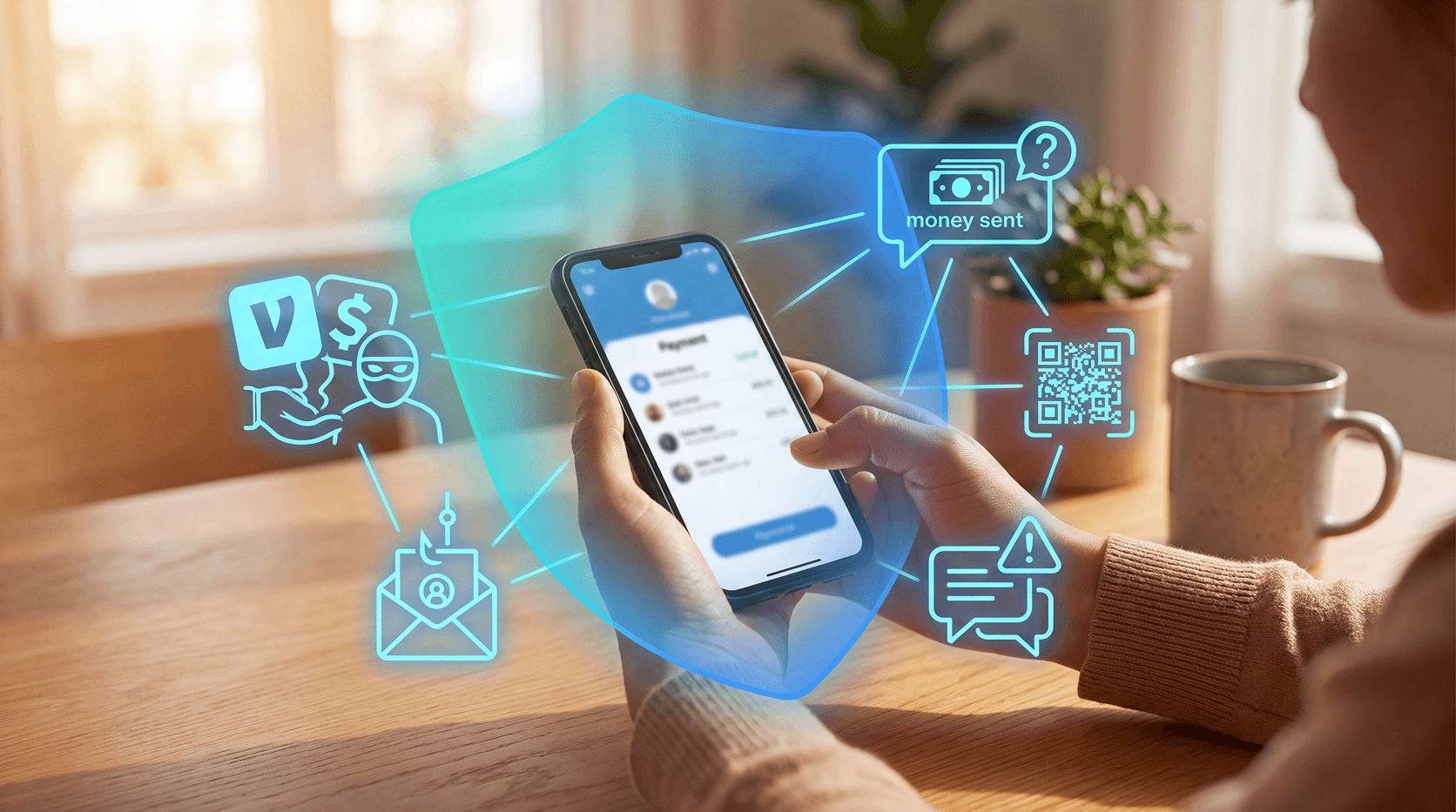
Key Takeaways
You split the dinner bill with a friend, pay your landlord for rent, or buy a concert ticket from a stranger online, all without ever touching a dollar bill. Venmo and Cash App have made sending money as easy as sending a text. And scammers have noticed.
In 2024, Americans reported losing a record $12.5 billion to fraud, according to the FTC's Consumer Sentinel Network Data Book. Payment apps have become a favorite hunting ground for criminals, because once you hit "send," the money is almost always gone for good. Unlike credit cards, peer-to-peer (P2P) transactions offer little to no buyer protection.
The good news? Most Venmo and Cash App scams rely on the same small playbook of tricks. Learn to spot them and you're already miles ahead of the average target. Here are the six schemes people keep falling for, and exactly how to avoid them.
Scam #1: The "accidental" overpayment
How it works: A stranger contacts you (often about a Facebook Marketplace listing, Craigslist item, or freelance gig) and "accidentally" sends you more money than agreed. They quickly message you in a panic: "I'm so sorry, I sent $500 instead of $50 by mistake! Can you send back the difference?"
You send the $450 difference. Then their original payment gets reversed, because it was made with a stolen credit card or a fraudulent bank account. You're out $450, and there's no one to chase.
Why it works: It feels like you're just being helpful and honest. The scammer exploits basic human decency.
Red flags to watch for:
- Someone you don't know sends you an unexpected payment
- They ask you to send money back via a different method (like gift cards or wire transfer)
- The original payment is larger than what was agreed upon
What to do: Never send money back to someone you don't know in real life. If you receive an unexpected payment, contact Venmo or Cash App support directly and ask them to reverse it on their end.
Scam #2: Fake customer support impersonation
How it works: You post in a Facebook group or tweet that you're having trouble with Venmo or Cash App. Within minutes, someone replies or DMs you claiming to be from "official support." They ask you to verify your account by sharing a one-time passcode sent to your phone, and just like that, they own your account.
Alternatively, you receive an email or text claiming your account has been suspended. The message includes a link to a convincing fake login page built to harvest your credentials.
Why it works: When you're frustrated and panicking about lost access or a frozen account, you're not thinking critically. Scammers manufacture the urgency.
Red flags to watch for:
- "Support" contacts YOU via social media DM or comment rather than through the app's official help center
- They ask for your PIN, password, or a verification code sent to your phone
- The email sender's domain doesn't match the official company domain (e.g.,
venmo-support@help-desk.net)
What to do: Real support from Venmo and Cash App will never ask for your PIN or one-time codes. Always go directly to the app or the official website, never follow links in unsolicited messages.
Scam #3: The "money flip" or investment scam
How it works: Someone reaches out on social media with an irresistible promise: "Send me $100 and I'll flip it into $1,000 in 24 hours." They may share screenshots of massive "payouts" or claim to have insider access to cryptocurrency trading, a stimulus program, or a Cash App promotion.
You send the money. They disappear, or keep asking for more to "unlock" your profits.
Why it works: The promise of fast, easy money is one of the oldest levers in the scammer's toolkit. On social media, fake testimonials and fabricated screenshots make these schemes look credible.
Red flags to watch for:
- Guaranteed returns or "risk-free" investments that sound too good to be true
- Pressure to act fast before the "opportunity" closes
- No clear, verifiable explanation of how the money is made
What to do: There is no legitimate "money flip." If someone promises to multiply your cash through a payment app, it's a scam, full stop. Report the account and block the sender.
Scam #4: Phishing texts and emails (fake alerts)
How it works: You receive a text or email that looks exactly like an official Venmo or Cash App notification: "Unusual activity detected on your account. Tap here to verify your identity and avoid suspension." The link takes you to a near-perfect clone of the app's login page, and everything you type goes straight to the scammer.
This is sometimes called "smishing" (SMS phishing) when it arrives via text message.
Why it works: The messages are convincing. Scammers spend real effort replicating branding, logos, and tone. The threat of losing access to your money creates immediate panic.
Red flags to watch for:
- Urgent language about account suspension, unauthorized access, or failed payments
- A link that, on close inspection, has a slightly off domain (e.g.,
venm0-security.com) - Requests for personal details like your SSN, bank account number, or date of birth
What to do: Don't click links in financial alert texts or emails. Open the app directly and check your account from there. Enable two-factor authentication on both Venmo and Cash App for an extra layer of protection. And consider a tool like Guardio, which flags malicious and phishing sites in real time across your browser and phone, before you can enter your credentials.
Scam #5: Fake prizes and giveaway scams
How it works: A message arrives (via text, email, or social media) congratulating you on winning a Cash App or Venmo giveaway: "You've been selected to receive $500! Just verify your account by logging in here and paying a small $10 processing fee." Sometimes the scammer even poses as Venmo or Cash App's official social media account.
The fee is gone the moment you pay it. There is no prize.
Why it works: Who doesn't want free money? These scams also often appear to come from official-looking accounts, complete with stolen brand logos.
Red flags to watch for:
- You're asked to pay a fee to claim a prize
- The message arrived out of nowhere, you never entered any contest
- The "official" account has very few followers or was created recently
What to do: Legitimate giveaways never require you to pay to claim a prize. Verify any promotion by going directly to the company's official website or verified social media handles. If you're unsure whether a message is real, treat it as fake.
Scam #6: Online marketplace and ticket scams
How it works: You find a great deal (concert tickets, a designer item, a puppy) listed on Facebook Marketplace, Craigslist, or a community forum. The seller insists on payment via Venmo or Cash App (and specifically asks you not to use the "goods and services" option on PayPal, which would give you protection). You pay. The item never arrives. The seller vanishes.
Ticket scams spike especially around major events: Super Bowl, Taylor Swift tours, and music festivals are recurring favorites for fraudsters.
Why it works: The deals are often just real enough to be believable. P2P apps are preferred by scammers because payments are instant and irreversible.
Red flags to watch for:
- A seller insisting exclusively on Venmo or Cash App with no alternative
- Prices that are dramatically below market value
- The seller can't verify the item (no video call, no additional photos, no proof of purchase)
- Pressure to pay quickly before someone else "takes the deal"
What to do: For marketplace purchases from strangers, use payment methods with buyer protection, like PayPal Goods & Services or a credit card. If someone insists on Venmo or Cash App only, that's a red flag. Meet in person for local transactions whenever possible.
How to protect yourself on any payment app
Knowing the scams is step one. Here's a quick checklist to stay safe:
- Only send money to people you know and trust. Venmo and Cash App are designed for friends, not strangers.
- Turn on two-factor authentication (2FA) on every financial account you own.
- Never share one-time passcodes, PINs, or passwords with anyone, including people claiming to be customer support.
- Treat unexpected incoming payments with suspicion. The overpayment trick is more common than you think.
- Use a dedicated email address for financial apps to reduce phishing exposure.
- Install real-time protection. Tools like Guardio automatically detect and block phishing sites, malicious links, and scam pages across your browser and phone before they can do damage.
The bottom line
Venmo and Cash App aren't going away, and neither are the scammers who exploit them. But with a little healthy skepticism and the right protective tools in place, you can use these apps confidently without handing criminals an easy win.
The single most important rule: if something feels off, stop before you send. Money that leaves your Venmo or Cash App balance is almost impossible to get back. A two-second pause could save you hundreds, or thousands, of dollars.
Guardio monitors for threats in real time across your browser and phone, blocking phishing links, fake login pages, and malicious sites the moment you encounter them, so scammers never even get a shot at your credentials.
Conclusion
Venmo and Cash App make it easy to move money in seconds, and that speed is exactly what scammers count on. Once a payment goes through, getting it back is rarely possible. Slow down before you send, and treat any unexpected or urgent message as a reason to double-check, not a reason to rush.
Get a free security scan with Guardio today and stay protected from payment app scams.
FAQs
Can you get your money back if you're scammed on Venmo or Cash App?
Getting money back after a Venmo or Cash App scam is very difficult. Both platforms treat P2P payments as final, similar to handing someone cash. Your best chance is to report the transaction immediately through the app and contact your bank if the funds originated from a linked account. Neither Venmo nor Cash App guarantees refunds for payments sent to scammers.
How do you know if a Cash App payment is a scam?
A Cash App payment is likely a scam if it arrives unexpectedly from someone you don't know, if the sender asks you to send money back, or if a message demands you pay a fee to claim a prize or unlock funds. Legitimate Cash App users and Cash App itself will never ask you to return overpayments or share your PIN or one-time codes.
What is the most common Venmo scam?
The most common Venmo scam is the accidental overpayment trick. A stranger "accidentally" sends you too much money and asks you to return the difference. The original payment is later reversed because it was made with a stolen card or fraudulent account, leaving you out the money you sent back.
Does Cash App have buyer protection?
Cash App does not offer buyer protection for payments sent to other users. Once you send money on Cash App, the transaction is typically final and cannot be reversed. For purchases from strangers, it's safer to use PayPal Goods & Services or a credit card, both of which offer dispute and refund options.
What should you do if you accidentally sent money to a scammer on Venmo?
If you sent money to a scammer on Venmo, report the transaction in the app immediately by tapping the payment and selecting 'Get Help.' Then contact your bank to report the fraud if a linked bank account was charged. File a complaint with the FTC at ReportFraud.ftc.gov and with the FBI's Internet Crime Complaint Center (IC3). Act quickly, time matters.
Is it safe to accept payments from strangers on Venmo?
Accepting payments from strangers on Venmo carries risk, especially if they then ask you to send money back. The overpayment scam works precisely because the initial incoming payment feels legitimate. As a rule, only transact with people you know personally, and if a stranger's payment arrives unexpectedly, contact Venmo support before taking any action.