What Is a Supply Chain Attack? How a Trusted App Update Can Deliver Malware


Key Takeaways
You kept your software up to date. You installed updates the moment they dropped. You did everything right.
And you can still be affected.
That's the uncomfortable reality of a supply chain attack. You weren't the target. The company that built the software you trusted was. And once attackers compromised them, your update became the delivery vehicle.
This kind of attack is particularly unsettling because it turns your good habits against you. Installing updates is still the right habit, but in these attacks it is also how the payload arrives. The more you trust a long-standing vendor, the less likely you are to question what they send you. Attackers understand this dynamic, and they exploit it deliberately.
Here's how supply chain attacks work, why they're so difficult to catch, what some of the most damaging real-world examples looked like, and what you can actually do to reduce your exposure.
What is a supply chain attack?
A supply chain attack happens when an attacker doesn't come after you directly. Instead, they go after a vendor, developer, or software provider you already trust, and use that relationship to reach you.
The term "supply chain" is borrowed from manufacturing and logistics. In a physical supply chain, a compromised component (say, a faulty part inserted at the factory) can end up in thousands of finished products before anyone notices. The same principle applies in software. If an attacker can compromise the source, they don't need to attack each customer individually. The distribution network does the work for them.
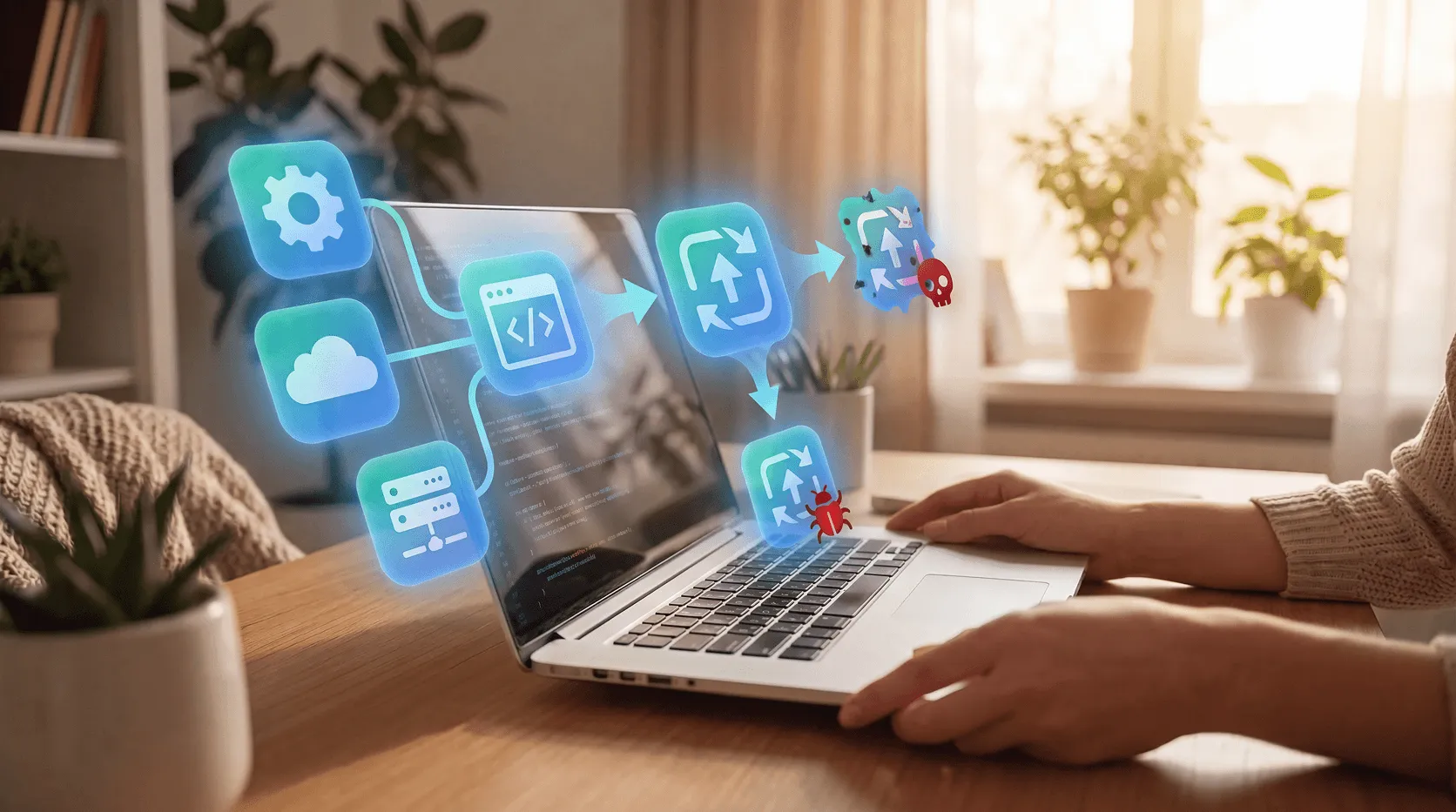
The mechanics are straightforward: attackers break into a software company's development environment, inject malicious code into the product, and wait. When the company releases its next update, that update goes out to many customers at once. Users install it willingly, because it looks legitimate. It is legitimate, except for the hidden payload riding along with it. The malicious code is bundled inside a real product, signed with a real certificate, and delivered through a real update channel.
Microsoft describes the goal clearly: attackers target "source codes, build processes, or update mechanisms by infecting legitimate apps to distribute malware." The malicious code then runs with the same trust and permissions as the original app, because as far as your system is concerned, it is the original app.
That's the core problem. The attack doesn't arrive as a suspicious email attachment or a sketchy download link. It arrives through the same channel you've used dozens of times before, from a source your operating system, your antivirus, and your own judgment have usually already approved. You can't see it coming, because it comes from exactly where you'd expect legitimate software to come from.
Why attackers love this method
Think about what a direct attack requires. You have to find a way past a person's firewall, antivirus software, browser protections, and general suspicion. Each of those layers makes a direct attack harder.
A supply chain attack often sidesteps them entirely.
When an update comes from a vendor you've used for years, your system usually doesn't flag it. Your antivirus usually doesn't quarantine it. You don't hesitate before clicking install. The attacker has essentially been invited inside, not because you made a mistake, but because you did exactly what you were supposed to do.
This is what makes supply chain attacks so attractive from an attacker's perspective. A single successful compromise of one software vendor can yield access to thousands or even millions of downstream targets. The effort-to-impact ratio is extraordinarily favorable. Rather than running thousands of individual phishing campaigns, an attacker can invest heavily in compromising one well-positioned vendor and let that vendor's own update infrastructure do the distribution.
The financial consequences reflect this scale. IBM's 2025 Cost of a Data Breach Report, as summarized by Breachsense, found that supply chain attacks cost an average of $4.91 million per incident, the second most expensive type of data breach after malicious insider threats. They also took an average of 267 days to identify and contain, the longest of any breach type. That figure measures how long it took to find and stop the incident, not how long attackers were inside, but it shows how hard these incidents are to spot.
They're expensive and prolonged precisely because they're hard to detect. The compromise happens upstream, outside your perimeter, in a place you have no visibility into and no ability to monitor. By the time the malicious update reaches your machine, the original intrusion may have happened months earlier at a facility you've never heard of.
Real attacks that used this exact method
These aren't hypothetical scenarios. Some of the most damaging cyberattacks in recent history used trusted software updates as the delivery method. Each of the following cases illustrates a different dimension of how supply chain attacks unfold in practice.
SolarWinds (2020)
This is the case that fundamentally changed how the security world thinks about trust in software updates.
Attackers the US government attributes to Russia's Foreign Intelligence Service (SVR) spent months inside the SolarWinds development environment before anyone noticed. They studied the build process, learned how updates were packaged and signed, and waited for the right moment. By February 2020, they had injected malware called SUNBURST into the company's Orion network monitoring platform, a product used extensively by large enterprises and government agencies to manage their IT infrastructure. When SolarWinds distributed routine updates starting in March 2020, up to about 18,000 customers installed the compromised version without any indication that something was wrong.
The malware was engineered to evade detection at every stage. It stayed dormant for up to two weeks (Mandiant found a randomly chosen threshold of 12 to 14 days) to help it avoid automated security analysis tools, which typically run in sandboxed environments for shorter periods. When it activated, it mimicked legitimate network traffic patterns to avoid triggering anomaly detection systems. The Treasury, Commerce, Homeland Security, and Justice departments were among the federal agencies affected (FedScoop), although Cyber Command said in March 2021 that it had found no evidence of compromise in Defense Department networks (The Record). The operation went undetected for more than eight months after the first malicious update shipped, and about 15 months after the attackers first got into SolarWinds, before cybersecurity firm FireEye discovered it while investigating its own breach.
The attackers tampered with SolarWinds' build process, so the malicious code was compiled into a legitimate Orion component and then signed with SolarWinds' genuine certificate (CISA). Signature checks that verify an update came from the vendor passed, because the update did come from the vendor's real pipeline.
CCleaner (2017)
CCleaner is a popular PC optimization tool trusted by millions of everyday users to clean up temporary files and improve system performance. In 2017, attackers compromised the build environment of its maker, Piriform, and inserted malware into an official release (version 5.33) that was signed with a valid certificate. About 2.27 million people downloaded it, and a second stage was delivered to a small number of targeted machines at technology companies (Cisco Talos, Avast).
The malicious version passed standard signature checks, because it was a legitimate build produced by the real build system. The only difference was the hidden code that opened a backdoor on infected machines, allowing attackers to collect system information and potentially deploy additional payloads to selected targets. The incident demonstrated that even widely used consumer tools, not just enterprise software, are viable targets for supply chain compromise.
3CX (2023)
In March 2023, a supply chain attack hit 3CX, a widely used business communications platform that the company says serves about 600,000 organizations worldwide for voice and video calls. This case had a particularly striking twist: Mandiant said it was the first time it had seen one software supply chain attack lead to another (Mandiant).
The attackers had infected 3CX not through a direct intrusion, but by first compromising a different software company, Trading Technologies, whose X_TRADER software was installed by a 3CX employee. That earlier compromise gave attackers a foothold inside 3CX's environment, which they then used to inject malicious code into the 3CX desktop application. One supply chain attack led directly to another, a chain within a chain.
The compromised 3CX app was then used to deliver additional malware to a small number of selected targets, reportedly including cryptocurrency companies. The incident illustrated that supply chain risk is not just one layer deep. A vendor you trust may itself be trusting vendors whose security posture you have no visibility into whatsoever.
How do you know if you've been affected?
That's the hardest part of this entire problem. Supply chain attacks are built to stay invisible. The malicious code is engineered to blend in with legitimate software behavior, avoid triggering security tools, and operate quietly for as long as possible. By the time one is publicly discovered, it has often been active for months, sometimes nearly a year, as the SolarWinds case demonstrated.
That said, there are signals worth paying attention to, even if none of them are definitive on their own:
- Unexplained network activity. Your device is reaching out to servers you don't recognize, especially at odd hours or in patterns that don't correspond to any app you're actively using. Many supply chain payloads need to communicate with attacker-controlled infrastructure to receive instructions or exfiltrate data, and that communication has to happen somewhere.
- Slower-than-normal performance after a software update, with no obvious reason. Malicious payloads running in the background consume CPU cycles and memory. If a routine update is followed by a noticeable and persistent slowdown, it's worth investigating rather than dismissing.
- Antivirus alerts triggered by a trusted app. This is rare, but it happens when a security vendor adds detection signatures for a known supply chain threat after the fact. An alert from a piece of software you've trusted for years is unusual enough to take seriously.
- A public disclosure from the vendor. Public companies must disclose material cyber incidents to investors within days, and many state laws require notifying people whose personal data is exposed, but vendors don't always warn customers about a compromised product. Check the vendor's security advisories page regularly, especially after a high-profile incident makes the news. If a vendor you rely on is named in a breach report, don't wait for them to contact you personally.
If a vendor you rely on has been named in a confirmed supply chain attack, check the vendor's advisory right away to see whether your version was affected, and follow its steps. Waiting for certainty before acting only gives attackers more time.
What can you do to protect yourself?
You can't audit every vendor's source code. You're not expected to. Most individuals and even most organizations don't have the resources or access to do that kind of upstream verification. But there are concrete, practical steps that meaningfully reduce your exposure and improve your chances of catching something early.
Keep software updated, but be selective about sources. Updates remain important: Verizon's 2026 Data Breach Investigations Report found exploited vulnerabilities behind 31% of breach entry points, the most common way in. But install updates through official channels only. Avoid third-party download sites, even ones that look reputable and professional. The official app store or the vendor's own website is the right place to get software and updates. If you're ever redirected to an unfamiliar domain to download an update, treat that as a red flag.
Enable security alerts for your devices. Whether you're on Windows, Mac, or mobile, turn on notifications for unusual activity. Operating systems and security tools that flag unexpected outbound connections or changes in app behavior can surface a problem much faster than waiting for a public disclosure. The sooner you know something is behaving oddly, the sooner you can investigate.
Add protection for the browser and the files you download. Guardio's browsing protection on computers and phones blocks phishing and scam sites before they open and explains why. Malicious Browser Extension Neutralizing detects and neutralizes bad extensions, which matters because an extension can also be compromised through its developer or an update, and Malicious Download Blocks block malicious downloads. Guardio doesn't scan the other software installed on your computer, so it can't spot a compromised app update like the SolarWinds or 3CX ones. Behavior-based endpoint security tools are better placed to catch unusual activity from installed apps, and no tool catches everything.
Check vendor security advisories regularly. If you use a piece of software regularly, bookmark the vendor's security page. Most major software companies publish advisories when there's a known problem with their product. Being among the first to know matters when an incident is actively unfolding and the window for containment is narrow. Don't rely solely on news coverage, advisories often go up before journalists pick up the story.
Don't use admin accounts for everyday tasks. The NSA's home network guidance recommends a non-privileged account for everyday activities. If malware does land on your machine through a compromised update, running as a standard user can limit what it can do. Admin access allows malware to install additional components, modify system files, disable security tools, and establish persistence across reboots. A standard user account makes the malware work harder for the same result. In the CCleaner attack, for example, the backdoor stopped if the user didn't have admin rights (Cisco Talos).
Segment and monitor your network where possible. For home users with multiple devices, a router that supports network segmentation can limit how far a compromise spreads. If one device is infected, segmentation (a separate guest or IoT network, for example) can limit how freely it communicates with your other devices (NSA). It doesn't stop a compromised app on the device itself. This is a more advanced step, but increasingly accessible through modern consumer routers.
The bigger picture
Supply chain attacks are a growing concern. Cyble tracked an increase of about 25% in incidents, from just under 13 per month (February to September 2024) to just over 16 per month (October 2024 to May 2025), with April and May 2025 averaging nearly 25. Cyble's counts are incomplete and swing widely from month to month, so treat them as a signal, not a precise measure. Verizon's 2025 report found third parties involved in 30% of breaches, double the year before. As more of the world's critical infrastructure, business operations, and personal life runs on interconnected software, the attack surface that supply chain compromises can exploit continues to grow.
Part of what makes this trend so difficult to reverse is structural. Modern software is deeply interdependent. Applications routinely incorporate dozens or hundreds of open-source libraries, third-party components, and external services. Each of those dependencies represents a potential entry point. Securing your own code is necessary but not sufficient when the libraries your code depends on may themselves be compromised, a dynamic that the security community has increasingly recognized as one of the defining challenges of the current era.
Conclusion
Supply chain attacks are a growing concern. They work because the digital world runs on trust, trust that vendors ship clean products, that updates improve rather than harm, and that software bearing a legitimate signature is safe to run. Attackers exploit that trust not by breaking through your defenses, but by walking in through a door you opened yourself.
Knowing that changes how you think about security. It's not just about what you do on your own machine, it's about who you trust, how you verify that trust, and how quickly you respond when that trust turns out to have been misplaced.
The good news is that awareness is half the defense. Understanding what a supply chain attack is, how it reaches you, and what signals to watch for helps you respond sooner.Pair that awareness with practical habits (getting software from official sources, checking vendor advisories, and limiting admin privileges) and you’ve meaningfully reduced your risk even in a threat landscape you can’t fully control. Browsing protection like Guardio adds a layer against compromised extensions and malicious downloads, but it won’t catch a compromised update to an app that’s already installed.
Get a free security scan with Guardio today and stay protected.
FAQs
What is a supply chain attack in simple terms?
A supply chain attack is when hackers compromise a vendor or software provider you trust, so their legitimate product secretly delivers malware to you. Instead of attacking your device directly, attackers get in through software you've already chosen to install.
Can antivirus software detect supply chain attacks?
Signature-based antivirus may not flag a supply chain attack at first, because the malware arrives inside a trusted, digitally signed application, until security vendors publish detections (Microsoft added detections for the SolarWinds malware after it was disclosed). Behavior-based tools that watch for unusual activity, like unexpected network connections or changes to system files, have a better chance of catching follow-on activity.
Was the SolarWinds attack a supply chain attack?
Yes. The SolarWinds breach in 2020 is the best-known example of a software supply chain attack. Attackers the US government attributes to Russia's Foreign Intelligence Service (SVR) injected the SUNBURST malware into SolarWinds' Orion software updates, which up to about 18,000 organizations installed, including US federal agencies such as the Treasury, Commerce, Homeland Security, and Justice departments.
How long do supply chain attacks go undetected?
Supply chain attacks are built to stay hidden. IBM's 2025 Cost of a Data Breach Report found that supply chain compromises took an average of 267 days to identify and contain, the longest of any breach type. The SolarWinds attack went undetected for more than eight months after the first malicious update shipped, before FireEye discovered it while investigating its own breach.
How can I protect myself from supply chain attacks?
Get software and updates from official sources only, use security tools that check the sites and extensions you use (such as Guardio's browsing protection on your computer and phone, which doesn't scan your other installed apps), watch for unusual device or network activity, check vendor security advisories regularly, and avoid admin accounts for everyday tasks to limit what any malware can do if it lands on your system.